

- 9
- 0
- 0
What Are Prediction Markets and How to Work With Them
Just a few years ago, most users placed bets primarily on sports or at casinos. Today, the situation is changing: more and more platforms allow users to predict the outcomes of real-world events—from elections and financial markets to tech announcements, the weather, or pop culture.
This format is known as “prediction markets.” For affiliates, this is no longer just an interesting niche but a new monetization channel that’s rapidly gaining momentum. In this article, we’ll explore why prediction markets are growing so fast, which platforms are already paying affiliates, which GEOs to focus on, and how to promote these offers without relying on traditional gambling creatives.
What is a prediction market and why is it popular?
A prediction market is a platform where users predict the likelihood of a specific event.
For example:
- Will Apple release a new product by the end of the year?
- Will Bitcoin exceed the $150,000 mark?
- Will a specific movie win an Oscar?
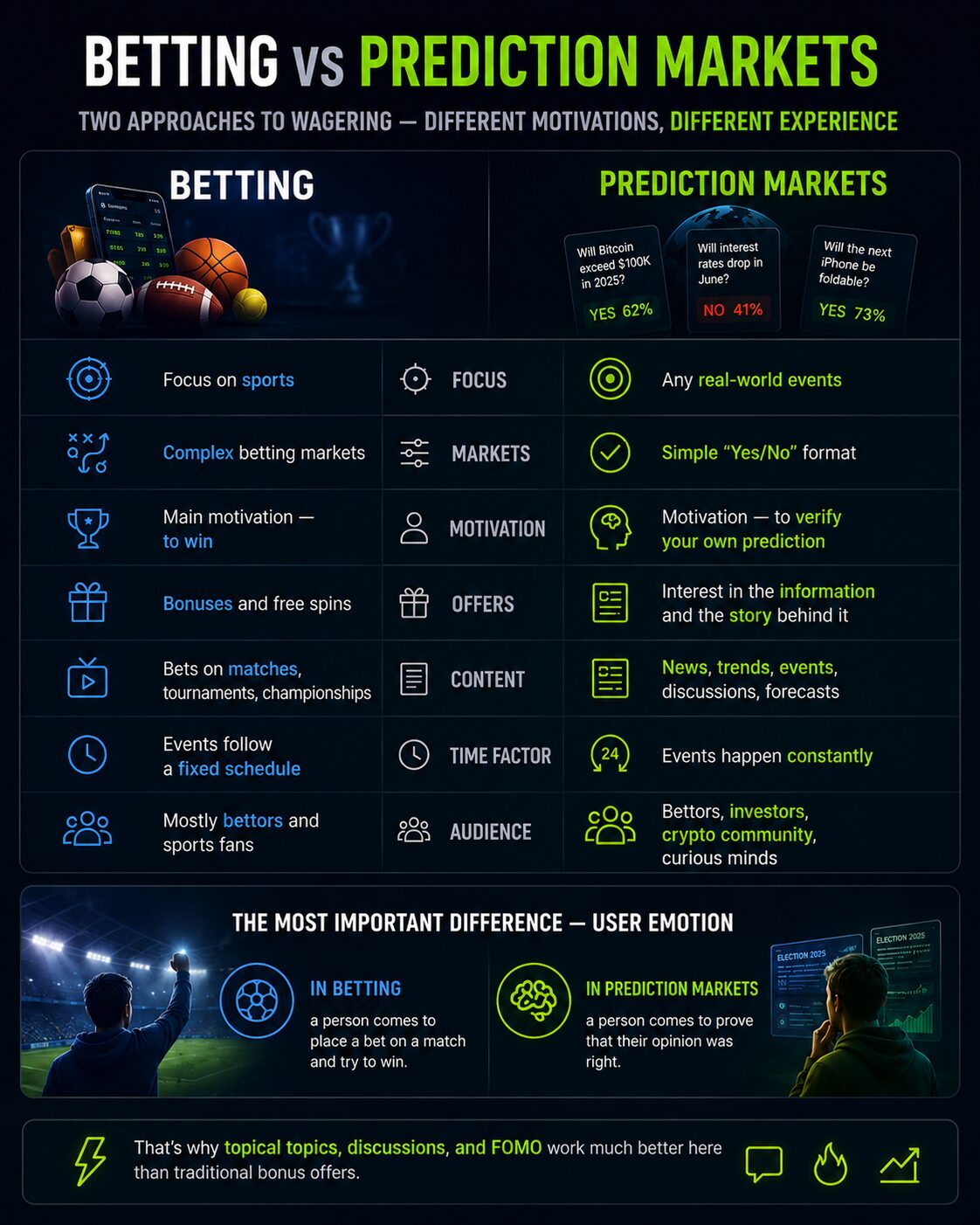
Unlike traditional betting, you don’t need to understand point spreads, handicaps, or sports statistics here. In most cases, users simply assess how likely an event is and purchase the corresponding prediction.
It’s this simplicity that attracts the audience. People interested in politics, finance, technology, and culture also flock here.
The growth rate of this segment is truly impressive. While the total market size was estimated at approximately $100 million in early 2024, it exceeded $44 billion just two years later.
Two platforms currently hold the largest market share:
- Polymarket — approximately $21.5 billion in trading volume;
- Kalshi — approximately $17.1 billion.
According to industry research, certain categories of prediction markets showed growth of up to 1,637% in just one year.
The SOFTSWISS report states that monthly trading volume rose from $32 million in January 2024 to $12.6 billion in January 2026. While the methodologies of various analysts differ, they all agree on one thing—the market is experiencing remarkable growth.
The reason for their popularity is quite simple. People are interested not only in watching the news but also in testing their own predictions. When any high-profile event turns into an interactive market with a “yes” or “no” answer, engagement increases exponentially.
The Difference Between Prediction Markets and Betting
The difference between prediction markets and betting
Popular platforms for prediction markets
Polymarket
The best-known prediction market platform, operating on a crypto infrastructure. Its primary audience consists of users already familiar with Web3, trading, or digital assets.
A referral program is available here once the required trading volume is reached. The terms include:
- 30% of commissions from direct referrals;
- 10% of second-tier commissions.
A separate affiliate program operates through Dub Partners, where CPA models are available. Previously, the platform tested pay-per-click, but as of 2026, this model is no longer in use.
Kalshi
Polymarket’s main competitor and one of the largest platforms for predicting real-world events. Its referral program is as simple as it gets: once the conditions are met, the referred user receives $25, and the affiliate receives the same amount. The reward can be withdrawn as soon as the new user’s activity is verified.
Generally speaking, there aren’t that many prediction offers available right now. Most affiliates work specifically with casinos and sportsbook products, which have already integrated their own prediction markets.
Which GEOs should you choose?
Of course, the U.S. remains the largest market, but it’s far from the only one.
Among the most promising GEOs are English-speaking Tier-1 countries, where users are already familiar with the crypto ecosystem and digital financial products. These include:
- Canada
- Australia
- New Zealand
- United Kingdom
- Ireland
In these countries, the audience is quicker to grasp the mechanics of prediction markets, and the cost of acquisition is usually lower than in the U.S. (surprisingly enough).
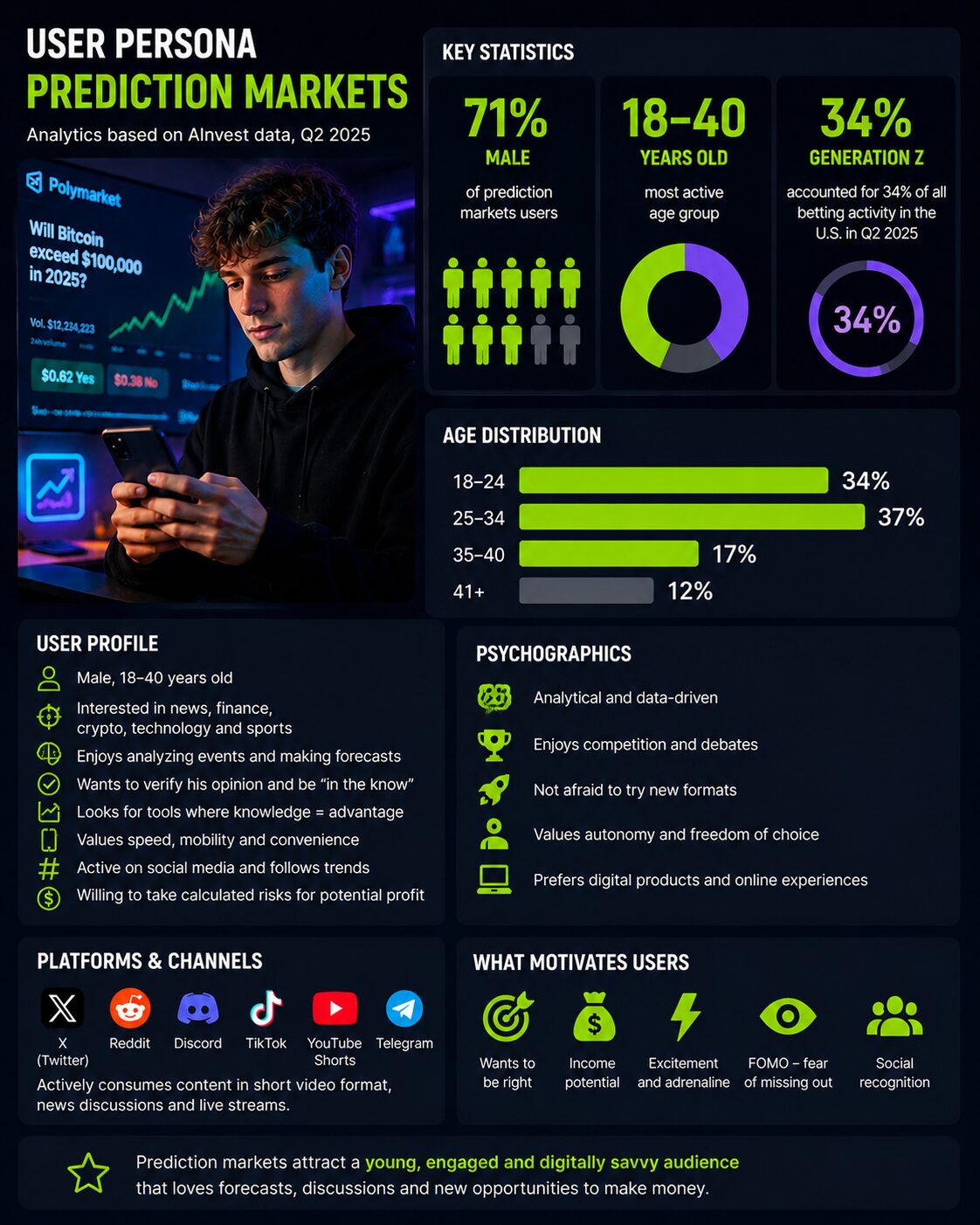
Target audience profile for prediction markets
How to promote prediction offers?
The most important thing here is not to try to promote predictions as regular betting. Users are primarily interested in the event itself: a big news story, a trend, a forecast, or a question they want to find the answer to. Therefore, it’s better to build your creative not around a bonus, but around a simple question that immediately sparks curiosity: “What if this really happens?”
Native content works best—short videos reacting to current events, UGC, news formats, discussions, and comparisons of different scenarios. For example, you can highlight a high-profile news story, offer your own prediction, and only at the end guide the user to the platform. In this format, the ad resembles regular social media content rather than a direct, in-your-face advertisement.
That’s exactly why classic gambling approaches (big bonuses, free spins, aggressive calls to action, and standard casino banners) may not generate the desired “boom” in this case. The audience is more interested in following the event, debating the outcome, and seeing whose prediction turns out to be correct.
It’s also worth using screenshots or screen recordings from Polymarket, Kalshi, and other platforms. The “Who Was Right?” format works well too: first, the prediction is shown, and after the event ends, the actual result is revealed. This approach creates a narrative and gives viewers a reason to come back for the next prediction.
Before launching, it’s important to consider speed. Prediction markets are closely tied to the news, so the relevance of your creative content can be measured not in weeks, but literally in hours. Because of this, it’s best to quickly test several storylines, GEOs, and formats, and highlight the winners as soon as the first results come in. And most importantly—build your creative around an event, a question, and an emotion, rather than around the payout or bonus itself.

In Summary
Will prediction offers become a new part of iGaming? It’s quite likely.
Prediction markets are no longer a niche crypto product and are gradually evolving into a separate segment of digital entertainment. The growth in volume, the emergence of affiliate programs, and the integration of prediction markets into casinos and sportsbook platforms indicate that the industry is just entering a phase of active development.
For affiliates, this means one thing: while competition is still low, there’s a chance to claim this niche before most other market players. Today, success here doesn’t go to whoever has the biggest budget, but to whoever is quickest to find a compelling news hook and turn it into content that people want to watch and discuss.

- 9
- 0
- 0
- By rating
- In order