- 33
- 0
- 0
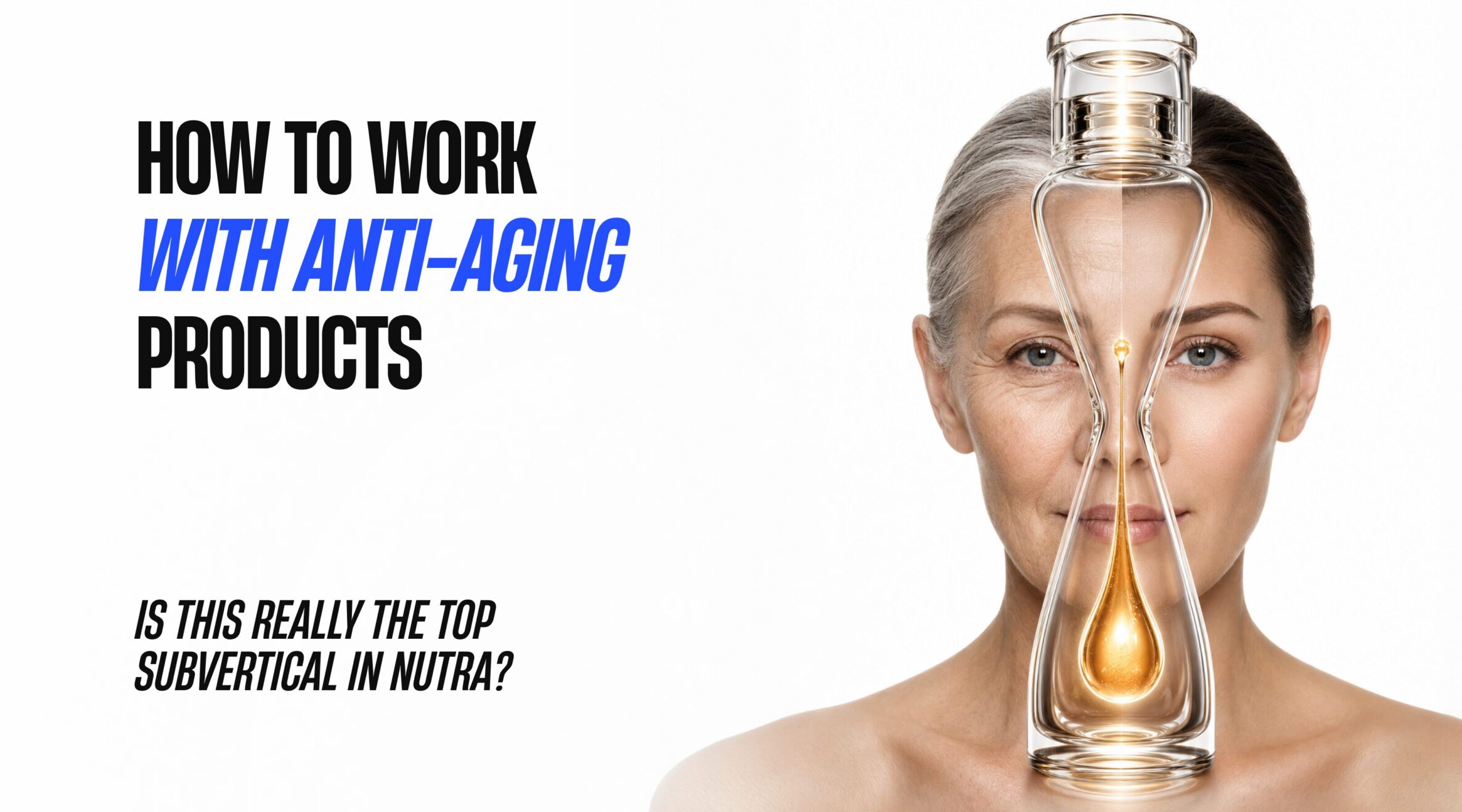
How to work with anti-aging products: Is this really the top subvertical in nutra?
AFFHUB is here! It’s been a while since we last talked about Nutra – one of the most widespread verticals in affiliate marketing.
Well, today we’ll take a closer look at the anti-aging products niche. It’s a fairly large segment that’s widespread literally all over the world, and, by the way, anti-aging products can be called one of the most profitable sub-verticals in the Nutra. And it all comes down to marketing psychology and humanity’s desperation.
So, friends, we invite you to read this article. Perhaps today, some of you will realize that you’ve found the perfect category of profitable offers. Let’s go see where the real money is hiding.
About the subvertical and its features
We didn’t mention that this subvertical is one of the largest and most profitable in Nutra for no reason. You’ll see for yourselves in a moment – just take a look at the mile-long list of target audiences.
The segment’s target audience: what’s it like?
Before we run any campaigns, it’s a good idea to understand exactly who we’re targeting. And here, the usual “women aged 25–50” can be safely thrown out the window. In Nutra, the target audience profile is a whole gallery of characters, each with their own struggles, mental hang-ups, and favorite ways to spend money.
- 25–30, a victim of social media. She sees yet another influencer with flawless skin and immediately wants the same. The main thing here is the visual. It has to be beautiful, stylish, and preferably make the product seem more expensive than it actually is. The more “premium” the vibe, the more interesting it is.
- 25–30, victims of Reels. For this category, the luxury trappings aren’t that important. Here, it’s the magic of “what if this is exactly what saves the day?” that works. If she sees a secret life hack in a Reel — then she has to try it. The main thing is for the ad to look like a continuation of that very video.
- 25–30, the Wikipedia victim. The toughest boss on this level. This person doesn’t just buy — they conduct their own investigation first. They read the ingredients, look up studies, compare components, and in particularly difficult cases, might even go to a lab. It’s almost impossible to convince this kind of buyer with a pretty banner.
- 30–40, “I did it all myself.” “I’ve achieved everything on my own” — that’s roughly their motto. Their budgets can vary widely, but they all have one thing in common: exhaustion. That’s why all sorts of claims like “maximum ingredients in a single product” can be particularly appealing. Because when you’re short on time, you want just one jar instead of five.
- 30–40, the skeptic who can’t be convinced of anything anymore. She’s tried so many creams that she could give lectures on the subject. Her faith in cosmetics is gone, but for some reason, dietary supplements and collagen still stand a chance — after all, they’re about inner health and all that. This segment has purchasing power, but a media buyer’s nerves are worth more.
- 30–40-year-olds who still feel like they’re 18–21. Their main fear isn’t wrinkles per se, but the feeling that their youth has slipped away without warning. That’s why messages about firmness, freshness, a well-groomed appearance, and regaining confidence resonate with them. But it’s best to save the classic “before and after” shots for another segment.
- 30–40 on maternity leave. Essentially any of the previous profiles, but with a baby in their arms and two minutes of free time. The formula is simple: one product—maximum effect—minimum hassle. And when it comes to pregnancy or breastfeeding, ingredients and safety automatically take center stage.
- 40–50s pursuing a healthy lifestyle. Here, “natural” can work better than any flashy promises. But there’s a catch: this segment actually reads labels. If the word “natural” is followed by the periodic table in the ingredients list—congratulations, you’ve lost them.
- 40–50s for whom life is a hard-earned luxury. For them, it’s not just about getting a product—it’s about getting a product of the right caliber. The packaging, presentation, and sense of exclusivity — everything must scream “expensive.” But don’t confuse this segment with people who casually drop huge bills at the cosmetologist’s (they’re usually not interested in the Nutra offers).
- 40–50, when menopause sets in. This is when a person may experience aging for the first time—not as an abstract prospect, but as a very real process. And that’s exactly why messages about supporting the body during this time of change can work very well. Some will say, “Oh well,” while others will try out anything they can get their hands on (just in case it helps).
- 50+. At this stage, there’s no need to sell the fantasy of turning 25 again (they’ve already figured it all out). The need is much simpler: they want their skin to feel better, their hair to stop falling out, and their bodies to get the support they need. That’s why multi-purpose products can seem especially appealing: why buy three jars when you can get one?
What about men?
They haven’t gone anywhere. It’s just that their needs are a little different. Here, the “short, clear, no 40-page novel” approach usually works best. Or you can show men the same problems and solutions as you do for women.
Is nutra always about seasonality?
Marketers who have been working in the Nutra industry for years have long been convinced that seasonality is literally sacred in this sector. Ignore it, and you’re doomed. But does this “sacred rule” apply to anti-aging products in exactly the same way as it does everywhere else? Well, no!
Interestingly, the seasonality factor has absolutely no impact on the target audience here. Logically, if a person wants to change their appearance (especially to look younger), it’s unlikely to depend on holidays, the time of year, the weather outside, and so on. But who said that seasonality doesn’t play a role at all? It does have an impact on offers specifically (we bet you’re a little confused by now, so we’ll explain everything).
As we’ve already mentioned, seasonality doesn’t affect the desire to look better or younger. That’s why there’s no perfect formula that guarantees that in winter, something “richer” will definitely perform well, in summer – antioxidants and lightness – and in fall or spring – “a vitamin-packed salad.” That might be partly true, but it’s still best to test things out. Take the time to figure out your own individual approach. You can also ask your affiliate manager which offers perform best during which seasons. But if even they can’t give you the answer you’re looking for – always remember that a high-quality offer and a powerful ad campaign can work wonders on their own.
Which GEOs are best for anti-aging products?
Actually, the GEOs here are very straightforward. We’d say – the usual suspects.
- Western Europe, Tier-1. For example, part of the audience here isn’t too fond of the “pharmacy vibe” and responds more readily to natural and eco-friendly products. This, however, doesn’t mean that a medical approach is out of the question here. It works – it’s just that instead of scientific rigor, it’s better to sell the idea of naturalness, safety, and transparent ingredients.
- North American Tier-1. Here, anything that screams “supernatural,” “eco,” and “at the DNA level” goes over well. That said, attitudes toward GMOs can be diametrically opposed: some despise them intensely, while others see them as the future. So be careful with generalizations.
- Latin America. Emotion can sell literally anything. DNA, “exclusive” formulas, sets, unusual concepts – if the creative concept resonates, the product already has a chance.
- Asia. Here, a multi-step skincare routine and a million little jars and bottles on the bathroom shelf are literally a way of life. That’s why sets of several products can look much more appealing than a single jar – especially if each step has a clear purpose. And there’s a special love for skin-brightening products. While one part of the world chases a bronze tan, spending thousands of dollars on trips to exotic destinations, the other part maintains a cult of snow-white skin (they’ve probably watched too many vampire movies – which, by the way, are also about eternal youth).
- Another Tier 2. Often, the love for the “ultra-luxury” format wins out – when everything looks downright expensive. But affordable natural products can also deliver great results. So don’t automatically assume that your audience only wants premium packaging.
- Another Tier 3. Here, the situation is almost the opposite: price usually matters a lot. But as soon as there’s a little “extra” money to spare, the desire for something as “luxurious” as possible doesn’t go away. If you’re just starting out, it’s better not to overcomplicate things and to test the mass audience with affordable offers.
What creative approaches should you use?
With anti-aging creatives, everything seems straightforward. Wrinkles, loss of firmness, and the feeling that your skin isn’t what it was when you were 20 — that pain is all too real. That’s why the good old “inner beauty” classic still works here.
But there are two points that are easy to overlook.
The first is your audience’s habits. For example, you honestly paused the campaign overnight because “nobody buys at night.” But that’s exactly when your target audience starts looking at themselves in the mirror, spotting a new wrinkle, and searching online for a way to get rid of it. It turns out you’ve just handed the prime time slot right over to your competitors. That’s why the same creative can yield completely different results on different websites.
The second point is adapting to the time of day. This doesn’t mean you now have to turn off ads during the day and wait until it gets dark. Otherwise, your budget will vanish in no time. It’s better to try splitting your campaigns—one for daytime, one for nighttime—and give each a different focus. At night, competition for traffic is often lower, so additional spend won’t necessarily be a disaster. And during the day, the offer gets what it needs—namely, the time it takes to catch a user’s eye.
So what should you do with the creative itself?
Tried-and-true classics still work, so let’s look at some approaches we’re all familiar with:
- News format. News works great when it features a well-known person. A mix of news and medical content can be even more effective. There’s only one rule: the celebrity must be familiar to your audience. If you’re targeting women aged 50 and older, a young “TikTok star” might not evoke any emotion. Conversely, a face that a mother recognizes won’t necessarily resonate with her daughter.
- Medical approach. A doctor on screen is a tried-and-true classic that advertisers have relied on for years. As we’ve already mentioned, it works especially well when paired with the news format: there’s an event, there’s a problem, and there’s an “expert” who comments on it. By the way, the character doesn’t necessarily have to be a real person. But there’s a downside: medical-themed creatives are used so often in native advertising that the audience has already learned to recognize them. As a result, their effectiveness is gradually declining. But it’s a bit too early to completely abandon the format—it’s still capable of generating decent conversions.
- The product as the face of the campaign. A timeless staple, so to speak. Simply showing the product in detail remains one of the most reliable approaches. That said, this approach often leads to a situation where it performs well on one website but gets banned on another. A lot depends on how aggressively it’s presented. A neutral approach is usually safer but may yield lower conversion rates. More aggressive creative can deliver significantly better results, but it also increases the risk of running into moderation issues.
- Before/After. It would seem obvious. But even here there’s a nuance: it’s impossible to know in advance exactly what will resonate with a specific person. For some, a prominent wrinkle across half the face is the perfect trigger, while others react to barely noticeable changes. That’s why it’s entirely possible to test several presentation options for the same segment within a single ad set. Then let the algorithm figure out for itself what each person likes. Yes, sometimes it feels like a guessing game. But if the copy, the target audience, and the offer itself are on point, the results usually don’t take long to show up.
- The magic of traditional medicine. Especially relevant for Tier-2 and Tier-3 markets. Take an ingredient familiar to the local audience, add a story about a traditional method of care, and you have a ready-made creative direction. But pay attention to one detail: the ingredient must be recognizable specifically to this geographic region. If a person is seeing it for the first time, “folk wisdom” quickly turns into just a discussion about natural ingredients. In the visuals, you can show a comparison between a traditional remedy and your product. If the ingredient itself already takes up half the packaging, there’s no need to explain its origin further. Overall, this is a good format for tests, but we wouldn’t recommend building an entire campaign around it.
- Natural ingredients. This is somewhat similar to the previous approach, but the two shouldn’t be confused. “Folk” is more about a familiar, culturally rooted ingredient. “Natural” is about the composition, certification, origin of the components, and an overall sense of safety. Moreover, the “natural” angle can work wonderfully even in Tier-1 markets. Especially when backed by clear certifications and quality assurances. But there’s a common mistake: making the word “natural” the star of the creative. On its own, it rarely creates a strong hook. It’s better to focus on another benefit—for example, a convenient product format—and leave “natural” as a nice bonus: “Oh, and the ingredients are good, too.”
In Summary
We think you’ve already seen for yourself that anti-aging products and similar cosmetics are more than just offers. Given the vast “target audience gallery” here, we understand that this topic is more relevant than ever and will likely remain so for a long time to come.
In addition, a major advantage is the ability to work in various GEOs. Whether in Tier 1 or Tier 3, this business is a huge hit (it’s no surprise that the desire to regain one’s former youth – or preserve it while there’s still a chance – is spreading all over the world).

- 33
- 0
- 0
- By rating
- In order