- 13
- 0
- 0
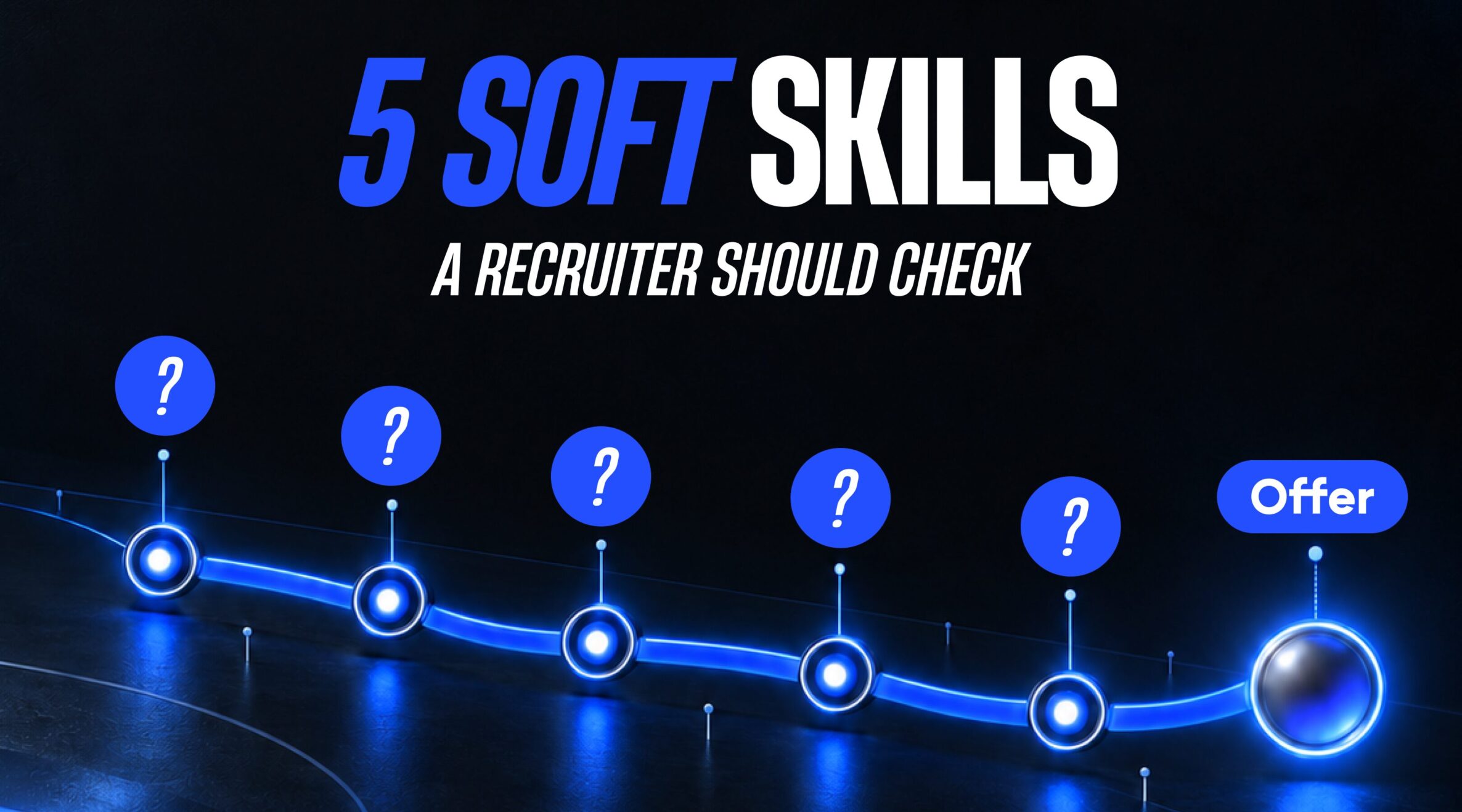
5 soft skills a recruiter should check
For many people, job interviews are incredibly stressful. For example, you show up with almost no experience and worry that you won’t be hired because of it. But if you knew just how much soft skills can outweigh hard skills, you wouldn’t even need another box of magnesium tablets.
In this article, we’ll briefly go over the soft skills that significantly influence a recruiter’s decision during numerous interviews. The ideal candidate isn’t just someone who knows a lot, but also someone who “gets it.” It’s important for a recruiter to find someone who can work effectively as part of a team and build strong relationships with coworkers. At first, this might sound cliché, but experience shows that seamless teamwork is a skill that, unfortunately, not everyone possesses.
So, check out the article below. We think that after reading it, you’ll stop viewing job interviews as a test of your knowledge under combat conditions and will be able to take note of the truly important points that will work significantly in your favor in your job search!
Adaptability: What Do You Do When Your Plan Suddenly Goes Out the Window?
In theory, the perfect workday exists about as much as perfect Wi-Fi anywhere in the world.
In reality, deadlines, priorities, clients, teams, tools, and even the task itself change (especially when we’re talking about the turbulent world of affiliate marketing). That’s why it’s important for a recruiter to understand how a candidate behaves when things don’t go according to plan.
Adaptability isn’t about being willing to accept any change with a simple “okay.” It’s the ability to quickly adjust, understand new circumstances, and keep moving toward the goal.
During an interview, this can be tested with a simple question: “Tell me about a situation where you had to drastically change your plan.” It’s not about how eloquently you describe the problem. The recruiter is looking at what you did after the problem arose.
Given the current global situation, which affects not only the affiliate industry but also other niches, adaptability is one of the key soft skills a recruiter will look for.
Critical Thinking: Not Just Following Instructions, but Thinking
There’s the employee who receives a task and immediately carries it out according to instructions. Then there’s the one who first asks, “Are we really sure this is the result we want?”
It’s not hard to guess that the second option is much more valuable to a business.
Critical thinking is the ability to analyze information, ask the right questions, identify cause-and-effect relationships, and not accept every idea as absolute truth.
For example, if an advertising campaign isn’t yielding results, a good specialist won’t just say, “The ad didn’t work.” They’ll try to figure out: Is the problem with the creative, the audience, the offer, or the hypothesis itself?
That’s exactly why recruiters often ask situational questions: “What would you do if…?” Here, they’re testing not your ability to guess the “right” answer, but the logic behind your reasoning.
Communication Skills: Just Because You Can Speak Doesn’t Mean You Know How to Communicate
You can be a brilliant specialist, but if your colleagues don’t understand exactly what you want from them, that brilliance won’t be of much use.
Effective communication is the ability to clearly articulate your thoughts, listen to the person you’re talking to, ask questions, explain complex ideas in simple terms, and strike the right tone depending on the situation.
A recruiter assesses this even before you receive a job offer. How clearly do you respond? Do you launch into a ten-minute monologue instead of giving a specific answer? Do you listen to the questions? And so on. All of this shapes the first impression of you, which will strongly influence employers’ decisions going forward.
A team without communication quickly turns into a game of “guess what I meant.” And business turns into an endless chain of messages: “What exactly was supposed to be done?”
Interesting fact: LinkedIn also highlights communication and adaptability as must-have skills that are relevant to many professions.
Accountability for Results: “I Did My Part” Isn’t Always Enough
This is one of the most interesting points for a recruiter.
A person may complete every task on the list, arrive on time, and meet deadlines. But do they understand why all of this is being done?
Accountability for results means that an employee looks not only at the action taken but also at its outcome.
If a designer creates a banner that doesn’t work, a responsible person won’t say, “Well, I did design it.” If a marketer launches a campaign that fails to deliver results, they won’t hide behind the phrase, “I set everything up correctly.”
This doesn’t mean taking the blame for everything that happens in the universe. It means being ready to say, “Here’s my result. Here’s what didn’t work. Here’s what I suggest changing.”
It’s exactly these kinds of people who build teams you can trust.
Two-way feedback: not just “What do you think of me?” but also “What can you offer me?”
A strong candidate doesn’t take feedback as a personal attack. They can listen to comments, ask clarifying questions, and use them to improve their work.
But there’s an important caveat: feedback must flow both ways.
Companies need people who can not only receive feedback but also give it constructively—without accusations or passive aggression, and with the ability to engage in a normal dialogue rather than create chaos in a chat or the office.
During an interview, a recruiter might ask how you’ve responded to criticism or whether you’ve ever been in a conflict with a coworker. This tests your maturity: can you address problems before they turn into a disaster?
In Summary
Why are these 5 soft skills so important? Because a team is much more than a group of strangers who don’t communicate with each other.
You can bring together ten very strong professionals and still end up with a weak team. If people don’t adapt, don’t think critically, don’t know how to communicate with one another, aren’t accountable for results, and aren’t able to provide quality feedback—the system starts to break down.
Conversely, a team where people can negotiate, ask questions, admit mistakes, and adapt to change has a much better chance of weathering any crisis, new project phases, and other global circumstances.
A modern job interview isn’t a test of “how well you know the profession.” The recruiter is trying to understand much more: how this person will behave when things don’t go according to plan.
Technical skills can be honed. A new program can be learned. A tool can be mastered. But the ability to think, communicate, adapt, and take responsibility for one’s own decisions forms a much deeper professional foundation.
And it seems that this is precisely why, in the age of AI, human skills aren’t going anywhere. On the contrary—their value is growing. Technology can help get the job done faster. But who will actually think, negotiate, make decisions, and take responsibility for the outcome? People, of course.

- 13
- 0
- 0
- By rating
- In order