- 154
- 0
- 0
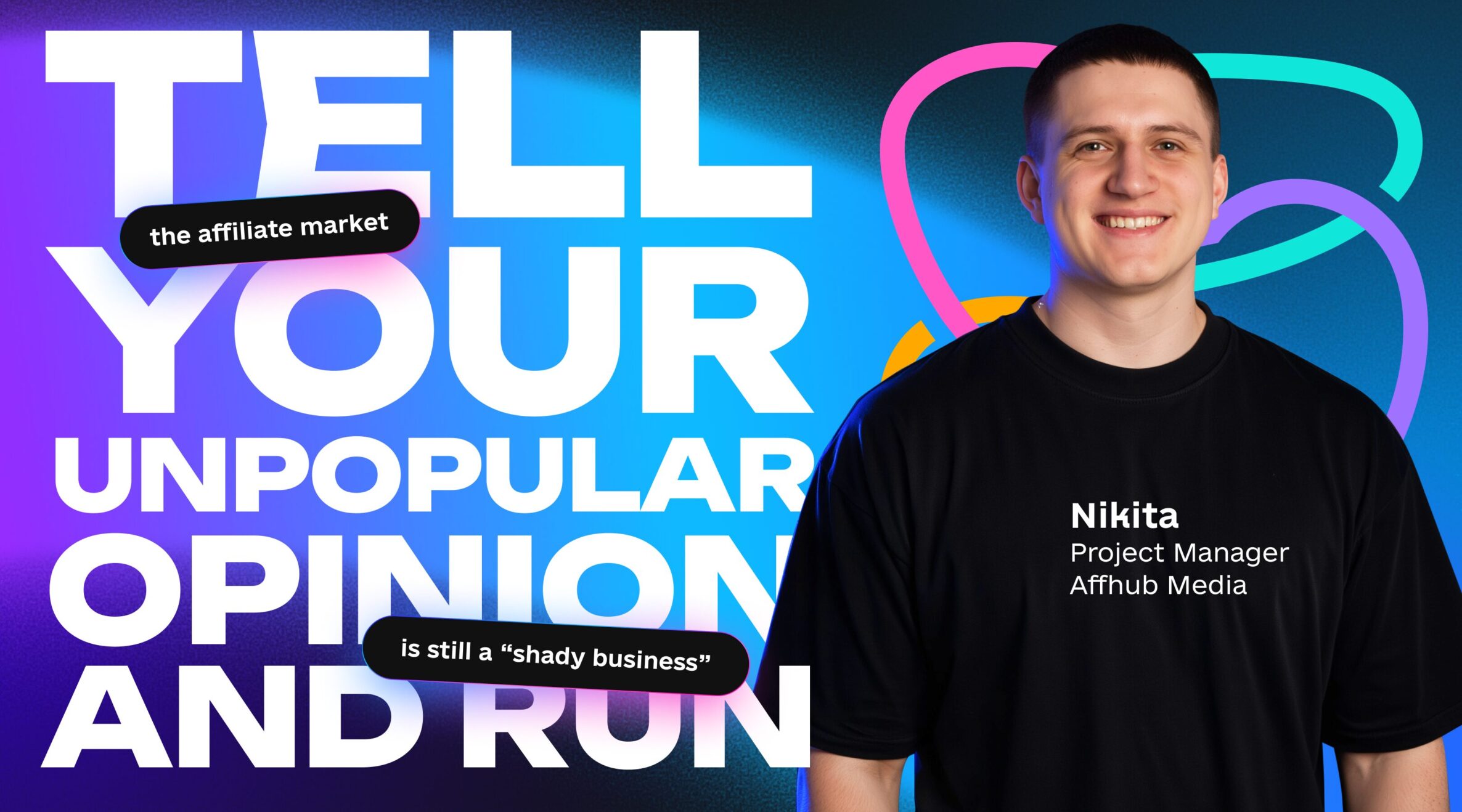
Speak your unpopular opinion and run: the affiliate market is still a “scheme”
Hi everyone! For those who don’t know me, let’s quickly introduce ourselves and get down to business. I’m Nikita, Project Manager at AFFHUB Media. I joined AFFHUB in 2024 as a writer; before that, I worked for a long time as a journalist, correspondent, and political commentator. In early 2025, I took over as head of the media department, and I’ve been in this role ever since. By the way, here’s a link to my new, work-related Instagram account. You’ll find short excerpts from all my columns and more there. So I will be waiting for your subscription.
Well, you really liked my last post. If you haven’t seen it yet, I recommend you to read it. Today’s topic, however, won’t be quite as popular. And you might even want to unfollow me after reading this. But before you do that, I’d still like to ask you to read this post all the way through.
Bold Statements
First of all—why did I even decide to write this post? The reason is very simple—interviews with many respected figures (no sarcasm intended; I truly respect these people) in our field. In every article about changes in the market, we hear quotes like, “The affiliate market is no longer just a ‘scheme’; it’s now a systematic business.”
And to get to the heart of the matter, let’s first figure out what is meant by the term “scheme.” After all, there are two interpretations here that seem similar at first glance. However, in practice, they’re very different.
The first interpretation: a “scheme” is something you can jump into quickly, make a profit, and walk away. And if we interpret the word this way, then yes, affiliate marketing is no longer a “scheme.” After all, to make any money here, you have to spend a lot of time learning and thousands of dollars making mistakes. And only after that will you have a small chance of actually earning anything.
I’m not revealing any secrets here when I say that the affiliate market has become significantly more complex in recent years. Traffic sources are getting hit with outages more and more often, regulations are restricting operations, and, frankly, the grass used to be greener. So yes, if you interpret the term “scheme” as described above, then you’re right.
However, there’s another interpretation of the word “scheme” (after writing this word so many times, it’s starting to lose its meaning for me, but there will be a lot more repetition of this term here, so I apologize in advance). And it means the opportunity to make good money by circumventing the system—this could involve deception, exploiting weaknesses, and so on. And if we take this particular interpretation, then yes, affiliate marketing is still that same “scheme.”
Why the affiliate marketing is still a “scheme”
I won’t get into the moral aspects of working with gray verticals here—a lot has already been written about that. And in practice, gray verticals (not black) aren’t about deception, but simply exploiting people’s weaknesses. So let’s skip that argument.
But to put it very simply—what is affiliate marketing when it comes to gray-hat verticals? It’s an attempt to bypass the source’s rules in order to show your ad to the user. Most of the time, an affiliate now spends not on setting up targeting or on marketing strategy, but on finding a scheme of advertising that Facebook won’t block within a couple of hours. In other words, affiliate marketing is essentially that “gray area” where affiliates try to circumvent the rules to make money.
And that’s what the entire industry is focused on. Most services are based on how to circumvent the platforms’ rules. Most content in the industry essentially boils down to the topic of circumventing the rules as well.
And this is where the key problem with these “schemes” arises—they aren’t permanent and are highly dependent on external factors. And here I’d like to elaborate a bit more.
Yes, right now it’s profitable for Facebook or Google to turn a blind eye to gambling ads. They do, of course, restrict them and make the process more difficult. But it’s simply in their best interest to provide a window of opportunity for this. To put this in perspective, according to investigative reports, in 2024 Meta earned approximately $7 billion from fraudulent ads (which journalists, for some reason, included casino ads in), accounting for nearly 10% of its total revenue.
In other words, once again, this situation is currently profitable for these companies. Of course, they publicly combat ads for illegal gambling, NFTs, or other gray niches; they impose restrictions and tighten controls. However, they don’t completely close all the loopholes. Because that’s where their profits come from.
But let’s imagine that everything changes tomorrow. Hypothetically, the son of the current U.S. president loses his fortune at an online casino (and he’s capable of doing so, given his love for futures trading and betting on political events), and his father decides that gambling must come to an end. Global pressure on casinos will begin. And it will be easier for Meta, Google, X, and other major, official platforms to close this loophole by giving up a portion of their profits. What will happen to the gray market for affiliate marketing in that case?
In fact, all major traffic sources—even those not based in the U.S.—play by U.S. rules in one way or another—just think of the TikTok ban. Therefore, most major traffic sources will be forced to completely stop running ads for online casinos. Of course, there are other ways to work with traffic; it’s not all about targeting. However, targeting is one of the biggest parts of the market. And so a scenario like this could wipe out an entire industry.
Of course, this is just a hypothetical scenario. And it’s not a given that something like this will ever happen. However, the affiliate market is exactly the kind of situation where your profit depends more on external factors. An example of this is during “active storms,” when teams lose huge amounts of money trying to deliver the promised traffic. And then, when things stabilize briefly, they try to recoup their losses.
And when your business no longer depends on you, but on external factors, that’s exactly what this “scheme” is all about. Of course, it may never end. Affiliates will continue to play cat-and-mouse, trying to get around the sources. And the sources, in turn, will introduce new restrictions that will shake up the market. But will it always be this way?
After all, every business depends on external factors, doesn’t it?
That’s true. However, most businesses are built around meeting people’s basic needs—feeding them, providing shelter, or ensuring their safety. And accordingly, even in the face of major upheavals, there will still be demand for such services. But will there be demand for online casinos if the government starts, say, jailing people for it?
Of course, there will always be people willing to take a gamble. People have been gambling for thousands of years, and they still do today. And the example of some Muslim countries, where gambling is a criminal offense, but operators still work with them, proves that gambling will certainly never die out. However, the volume of this traffic—and with it, the profits—will drop significantly.
So why shouldn’t I be hated?
Of course, for many business owners in the affiliate industry, it can be unpleasant when someone calls their field a “scheme.” And that’s normal. But, in my subjective opinion (I emphasize this word, since this column reflects the author’s subjective view), the affiliate market has always been, is, and will continue to be that “scheme”, in the sense described above.
Is that a bad thing? Definitely not. All of us, when we got into this, accepted the rules of the game. Does that mean the industry will die out? As I’ve already noted, it all depends heavily on external factors. Maybe this industry will only thrive in the future. Or maybe tomorrow there will be a massive collapse and all the companies will be forced to shut down. No one here knows for sure.
However, as long as this industry exists, I’m personally having the time of my life. Because it’s in affiliate marketing that I’ve found the very vibe I’ve been searching for throughout my relatively short life. After all, affiliate marketing is, first and foremost, about goal-oriented people. They’ve set themselves the goal of making money, and they’re doing just that.
Even in our relatively small Ukrainian affiliate market, there are plenty of success stories where people who had nothing as children have now become owners of large businesses with multimillion-dollar profits. And these examples inspire others, keeping them up at night to check their bank balances. To stress over tight budgets and rejoice in a positive ROI. Everyone in our field is motivated. After all, let’s be honest—without motivation and discipline, you won’t achieve anything in affiliate marketing.
So yes, in my opinion, the affiliate industry is still a tough field. But I love this scheme, I love this market, and I love our audience.

- 154
- 0
- 0
- By rating
- In order