- 34
- 0
- 0
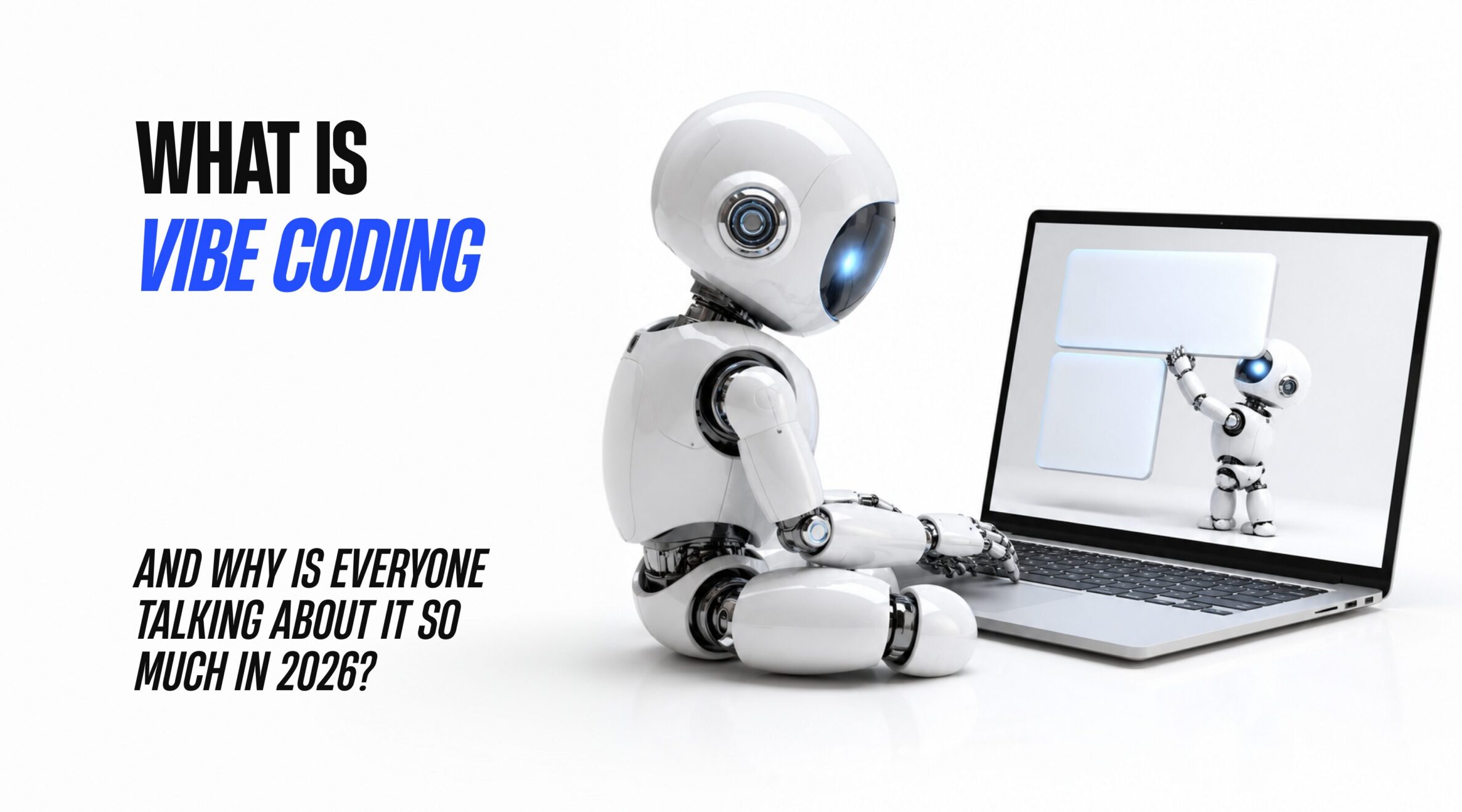
What is vibe coding, and why is everyone talking about it so much in 2026?
Until relatively recently, you needed a developer to create your own website, app, or internal service. And if the product was going to be more complex—you needed an entire team…
Today, you can start part of this work with literally a single message to a chatbot: “Create a dashboard for me to monitor ad campaigns. Include a spending chart, ROI, a campaign table, and a GEO filter. Make the interface minimalist and easy to use on a laptop.”
In just a few minutes, AI can turn such a description into a working prototype.
This approach has been dubbed “vibe coding.” The term gained popularity following a post by Andrew Karpati in February 2025. He described a workflow in which a person primarily formulates tasks in natural language, while the model generates and modifies the code.
And here it’s important to understand the key point: vibe coding is not “programming without programming.” It’s a shift in the human’s role in the software development process.
The difference between traditional development and vibe coding
Traditional development typically begins like this:
- implement a feature
- design a solution
- write code
- test
- fix bugs
- integrate.
In vibe coding, the first step is different: explain to the AI what result you want to achieve.
Then a dialogue begins. For example, let’s say you want a small service to manage your finances.
- First, you write: “Create an app where I can add income and expenses.”
- Then: “Add expense categories.”
- Next: “Show a graph of expenses for the last six months.”
- Another request: “Add a filter by category.”
- And then: “Make a mobile version and add a dark theme.”
The AI gradually refines the product according to the new instructions. It is precisely this cycle of request—result—verification—refinement that is one of the key principles of AI-assisted development.
BUT: Despite the popularity of this approach, it would be a mistake to say, “We no longer need programmers.” We do need them. And how! The only difference lies in the stage at which a human gets involved in the work.
In traditional development, a specialist designs the architecture, writes the code, tests it, and maintains the system.
In vibe coding, a person defines the requirements, manages the process, verifies the result, and asks the AI to make changes. In other words: a person sets the goal, oversees the process, and verifies the result, while the AI helps implement the request. But the more complex the product becomes, the more important technical knowledge and human involvement in the development process become.
AI can write code that looks correct (at first glance). But later on, you may discover a whole host of flaws that will prevent the website from functioning properly.
Even if everything looks fine at first, this doesn’t necessarily mean that the code is:
- secure;
- optimized;
- scalable;
- easy to maintain;
- or functions correctly in all scenarios.
A 2025 Veracode study showed that 45% of the tested AI-generated code samples contained flaws related to the OWASP Top 10. In a 2026 update to the study, Veracode also reported that only 55% of the code generated in their test set was secure. And this is a very telling point.
AI can do a great job of creating a beautiful registration form.
But the question is whether that form will properly handle personal data, authentication, access rights, and potential attacks, among other things.
Do you need to learn programming to do vibe coding?
If you don’t know how to program, AI can be a very fast generator for you. But when a person starts to rely entirely on artificial intelligence, it can lead to a number of unpleasant situations. We’ll explain why below.
For example, if you know how to program, you already understand:
- which architecture to choose;
- where problems might arise;
- which code needs to be rewritten;
- how to check security;
- what needs to be tested;
- when AI suggests a questionable solution.
In this case, AI is an assistant that saves you time and partially simplifies your work. This leads to the model of “human + AI,” rather than AI replacing humans.
When the opposite is true, here’s what can happen:
Let’s imagine a scenario. You asked the AI to create an app. It works. You add another feature. It works. Another one. That works too… Everything’s great, right?
A month later, you already have hundreds of files, dozens of dependencies, and logic that you don’t fully understand yourself.
And then a small problem arises. Fixing one component breaks another. The AI suggests a solution. It creates a new problem. And gradually, a chasm forms that you can’t climb out of because you simply don’t know how.
That’s exactly why it’s still important to understand programming if you want to get into vibe coding. In fact, the problem with this newly created field is that many people think: “Oh, so someone spent years studying to become a programmer, but I can just jump into this niche in a week with no experience. Wow, I’ve got to try this!” It sounds truly fantastic, but that’s exactly why this idea is fantasy—because it isn’t entirely true.
What tools are used for vibe coding?
- Claude Code. An Anthropic tool (which everyone’s been talking about) for working with code via the command line and tackling more complex development tasks.
- Lovable. Focused on creating web applications using natural language. The company reported that in 2025, about 100,000 new projects were being created on the platform every day.
- Cursor. An AI editor for those who want to work directly with the codebase and have more control over implementation.
- Replit. A browser-based environment where AI can help turn a text description into a working project.
Even the most expensive AI won’t produce a “wow” result from a bad prompt
One of the biggest mistakes beginners make is expecting that it’s enough to write: “Build a website for my company.”
AI will, of course, create something. But most likely, it won’t be a result that resembles the greatest technological breakthrough in human history.
Not sure how to craft a prompt correctly? Tell the chatbot what you want to see on the website and ask it to formulate a high-quality, detailed prompt tailored to your task. Here’s what ChatGPT generated for us:
“Create a one-page website for an agency specializing in performance-driven digital marketing.
At the top of the page, create a strong, concise headline that immediately communicates what the agency does, followed by a short description of its main service and a prominent call-to-action button encouraging visitors to submit an inquiry.
Below the hero section, add a section showcasing the agency’s three main areas of expertise. For each area, provide a short description and clearly explain the key benefit it offers to clients.
Next, create a portfolio section featuring completed projects and their results. For each project, include the project name, a brief description of the challenge, the approach used by the agency, and the results achieved.
After the portfolio, add a dedicated testimonials section displaying client reviews in clean, easy-to-read cards or a carousel.
At the bottom of the page, include a contact form with the following fields: name, email address, and message. Place a short, persuasive call-to-action next to or above the form encouraging visitors to get in touch with the agency.
The visual style should be modern, clean, understated, and professional. Use a dark interface with one bright accent color for buttons, important elements, and visual highlights. Avoid excessive decorative elements. Maintain a clear visual hierarchy and provide sufficient whitespace between sections to keep the page easy to scan and visually balanced.
The website must be fully responsive and look equally good on desktop computers, tablets, and smartphones. All elements should automatically adapt to different screen sizes. Navigation and the contact form must remain intuitive and easy to use on mobile devices.”
Of course, this is just an example. You can write whatever you like. But such a detailed prompt is more likely to meet your needs than a single sentence.
When does vibe coding really make sense?
As we’ve already mentioned, vibe coding shouldn’t be seen as a universal replacement for traditional development. Its main advantage lies elsewhere: it allows you to quickly test an idea, build an initial version of a product, or automate a small task without having to immediately assemble a full-fledged development team.
The most obvious scenario is when you have an idea but don’t yet know how much people actually need it. In such a situation, it doesn’t make much sense to spend months developing a complex product, invest a significant budget, and only then realize that users don’t need it. With AI, you can create a simple prototype much faster, show it to potential users, gather their feedback, and determine whether it’s worth moving forward. If the hypothesis is confirmed, then you can proceed to full-scale development.
Vaybcoding can be just as useful for small internal tasks. For example, a team might need a simple calculator, a request tracking system, a small tracker, or a handy tool for working with data. Such things don’t always require a separate software product that would take weeks to develop. Sometimes it’s enough to properly formulate the task for the AI, test the result a few times—and get a tool that meets a specific need.
It’s also suitable for automation. If you perform the same routine task every day, it’s worth at least checking whether it can be simplified. Processing spreadsheets, sorting information, preparing reports, working with files, or other repetitive processes can be automated by creating your own small tools. In this case, vibe coding becomes a good way to save time.
But this is exactly where you need to draw a clear line. Vibe coding is great to use in situations where a mistake won’t cost you roughly the entire value of your business.
However, if the system handles users’ money, personal or payment data, corporate infrastructure, or mission-critical processes, the development requirements become entirely different.
The same applies to products that are designed to serve a large number of users or require a complex authorization system, a high level of security, and long-term support. It’s not enough for the application to simply launch and perform its basic function. You need to understand how it will behave under load, how secure the data is, what will happen in an unusual scenario, and how easy it will be to maintain and expand the system a year from now. And this is precisely when the key question arises: can we entrust a critically important part of our business to this code?
In summary
Vibecoding doesn’t eliminate the profession of a programmer. It changes the very entry point into development. AI has made programming more accessible. But accessibility doesn’t equal expertise. Putting together something that works is much easier today. But building a reliable, secure, scalable product that can be maintained for years remains a challenging engineering task.
That is precisely why the most powerful combination in the coming years will likely not be “a vibe coder instead of a programmer,” but rather a specialist who understands programming technology and knows how to use AI as a tool to accelerate their work.

- 34
- 0
- 0
- By rating
- In order