- 18
- 0
- 0
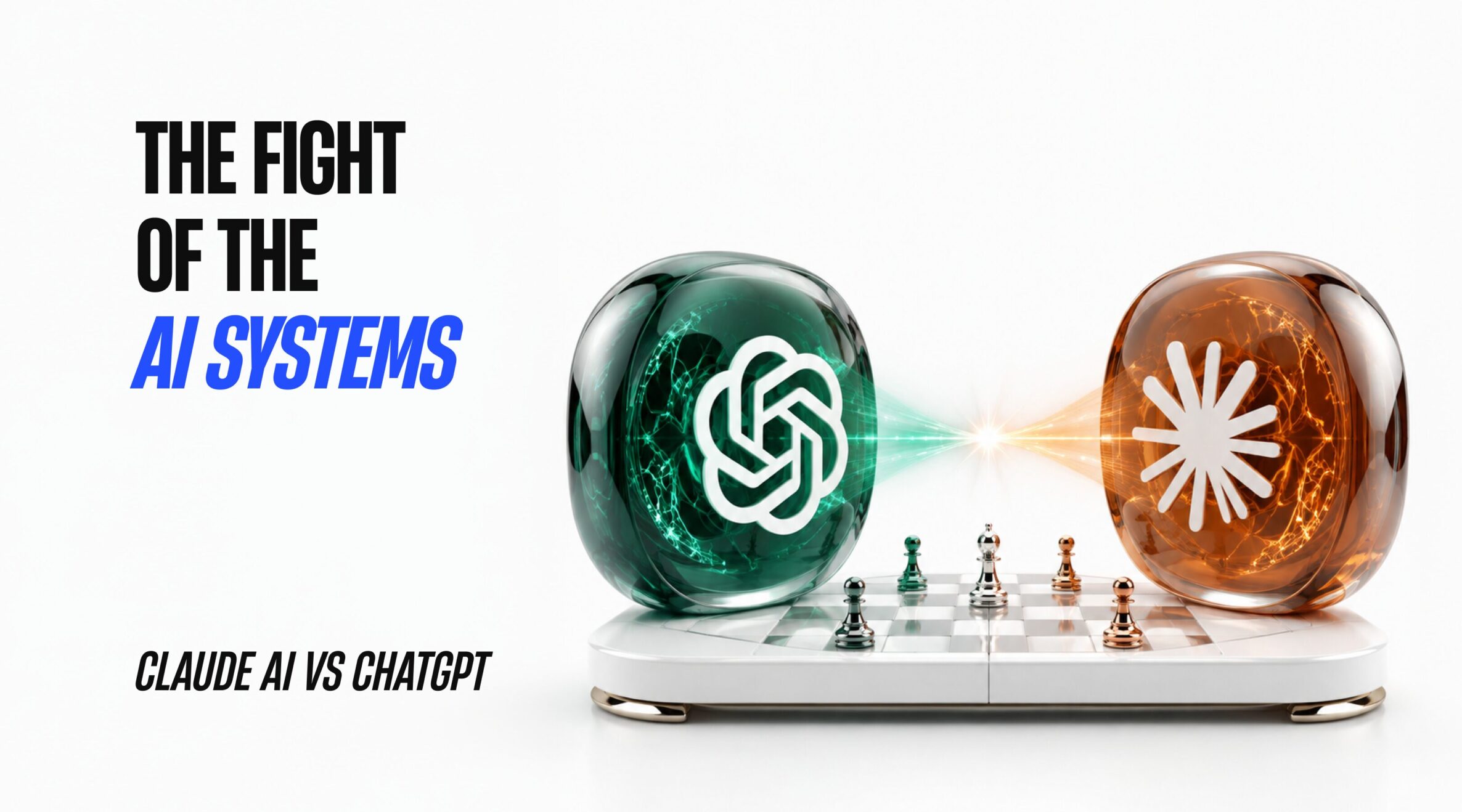
The fight of the AI systems: Claude AI vs. ChatGPT
We think most of you first used AI after OpenAI released the now-famous chatbot—ChatGPT.
For years, ChatGPT dominated the artificial intelligence industry. There was a lot of hype surrounding it. The chatbot evolved steadily, transforming from a “dumb bot that spouts false information” into a “genius capable of answering many questions, solving complex problems, generating realistic images, and more.”
But other tools were developing alongside it, and they eventually became serious competitors to ChatGPT. One such worthy rival was Claude from Anthropic. Upon its arrival on the market, experts from various fields quickly recognized its capabilities. But at that point, they didn’t consider it a replacement for GPT. However, as you might guess, AI never stands still. By 2026, Anthropic had refined the tool and launched Claude Code, which very quickly went viral in the media.
And that’s when many users were faced with the main question: Which one to choose—ChatGPT or Claude? Which is stronger, and which will win?
Well, read on—we’ll figure it all out right now!
Who is this ClaudeAI?
It seems hard not to know about Claude, but for those who aren’t familiar with it yet—it’s time to get acquainted!
Claude was founded by Anthropic in 2021. Interestingly, former leading researchers at OpenAI—Daniela and Dario Amodei—played a key role in this process. Claude is, in essence, a family of language models. Here, the developers have emphasized safety, accuracy of responses, and smoother performance (remember that ChatGPT was initially optimized for speed and mass adoption). ClaudeAI currently runs on version 4.6 models—the perfect combination of the efficient Haiku, the balanced Sonnet, and the most powerful Opus. You can use it on both a PC and a smartphone.
Before its release, Claude underwent extensive training. This model was trained using the concept of Constitutional AI. This is an approach in which artificial intelligence evaluates its own responses based on a set of ethical principles and rules, making it more resistant to fraudulent schemes and various forms of manipulation aimed at hacking.
Anthropic’s Marketing Move
In February 2026, Anthropic achieved significant success thanks to a bold marketing decision. During the Super Bowl, the company launched a campaign with the slogan: “No Ads” (advertising against advertising—sounds intriguing).
The thing is, at that time, many AI platforms had begun testing ad monetization and sponsored posts in the form of responses to user queries. Anthropic opposed this, as its priority was a convenient and clean workspace free from outside commercial influence.
Shortly thereafter, the Claude app made it into the top 10 most-downloaded productivity apps worldwide.
What interesting developments took place with Claude in 2026?
2026 can be called a year of technological breakthrough for Anthropic. The company shared with users a whole suite of autonomous agent features, which many have already come to appreciate.
The Opus and Sonnet 4.6 Models
One of the standout features of the new Claude models was the expanded context window—up to 1 million tokens in beta mode. In practice, this means that users can work with very large amounts of information within a single session: upload voluminous documents, large sets of materials, or even entire books without having to split them into dozens of separate parts.
Claude Code
A separate area of development for Claude is Claude Code, a tool that has become one of the examples of a new generation of AI agents for programming.
Unlike a typical chatbot, it works directly with the codebase via the command line. The agent can analyze a project’s structure, review files, run tests, identify the cause of an error, and suggest or implement the necessary changes. In certain scenarios, it is also capable of preparing changes for Git and committing them.
Now, AI is not just a bot that offers comfort in a tough moment, but a full-fledged assistant that will even do some of the work for you. It is precisely this close integration between the model, the development environment, and project tools that has made Claude Code one of the most notable AI solutions for working with source code.
Computer Use
A feature that allows Claude to interact with a computer via a graphical user interface, effectively performing actions on the user’s behalf.
The model can open the necessary programs, interact with interface elements, move the cursor, enter data into forms, and sequentially perform routine operations. In other words, instead of simply being told “how to do it,” the user can assign a task, and Claude will carry out the necessary steps in the digital environment. Isn’t that wonderful!
Claude Cowork and Microsoft 365
Another area of focus is the integration of Claude into corporate workflows. The arrival of Claude Sonnet in the Microsoft 365 and Copilot ecosystem has expanded the model’s business applications.
For companies, this means that AI is no longer just a standalone chatbot but a team member (as eerie as that may sound) who works with documents, information, internal processes, and day-to-day tasks.
According to data released by Anthropic, Claude is currently used by about 70% of Fortune 100 companies, demonstrating the platform’s widespread adoption in the corporate sector.
And of course, there’s always drama: Anthropic’s conflict with the Pentagon
In early 2026, one of the most high-profile debates at the intersection of artificial intelligence, government, and the defense sector unfolded around Anthropic.
In late February, the U.S. Department of Defense began demanding broader access to Claude’s technology for military applications. Potential use cases under consideration included not only standard analytical tasks but also systems related to autonomous technologies and government surveillance.
Anthropic’s leadership refused to abandon its own restrictions on such scenarios. The company insisted that its technologies should not be used for mass surveillance or fully autonomous use of force.
The situation quickly escalated from a corporate dispute into a large-scale debate about where exactly the boundaries of AI use by government agencies should lie.
Meanwhile, OpenAI adopted a different strategy and reached an agreement with the U.S. defense sector regarding the use of its models in secure military environments.
This difference in positions attracted significant attention from users. Social media users began actively discussing the choice between platforms, and Claude received another wave of attention and new users.
For part of the audience, the story became more than just a corporate conflict. It turned into a matter of trust: how far are AI developers willing to go for government and military contracts?
Why do programmers choose Claude?
Claude has gradually built a reputation as a tool focused not only on generating individual code snippets but on working with a software project as a whole.
One of its main advantages is its ability to handle large amounts of context. In supported modes, the model can handle massive amounts of information, which is particularly useful when analyzing large repositories.
This makes it possible to view the code not as a set of independent files, but as a single system. For developers, this is crucial during large-scale refactoring, when searching for interrelated bugs, or when changing the project’s architecture.
Claude Code
Its significant advantage is that it can work directly with the project: browse files, analyze their structure, execute commands, run tests, and verify the results of the changes made.
In other words, a developer can set a task, such as: “Find the cause of this error, fix it, and check that nothing broke after the changes were made.”
The agent is then capable of performing a significant portion of the technical work on its own. It is precisely this shift from the “AI writes code on demand” model to the “AI performs part of the development process” model that has caused such a buzz around the service.
Adaptive Reasoning
Another strength of modern models is their ability to allocate more computational resources to complex tasks without overcomplicating simple queries with unnecessary reasoning.
This is particularly useful for programming. A simple change in a single file can be made quickly, while the model can analyze a complex bug or architectural problem in much greater depth.
As a result, the developer achieves a balance between speed and the quality of the response.
RLAIF and Anthropic’s Approach to Training
Anthropic has placed significant emphasis on RLAIF—an approach in which evaluation by other AI systems plays a major role during model training.
The idea is to train the model not only to generate the correct result but also to adhere to established principles of behavior: to be useful, consistent, and to ensure maximum privacy and security during use.
For programming, this has practical implications: the quality of code is determined not only by whether it runs, but also by how understandable, maintainable, and predictable it remains after changes.
Claude vs. ChatGPT
Let’s be honest: as of 2026, both platforms have advanced significantly in terms of programming and overall capabilities. Typically, the difference lies not so much in the “power” of one over the other, but rather in how well the model aligns with specific queries.
When Should You Choose ChatGPT?
ChatGPT is well-suited for situations where the user can clearly formulate a query. If there is a detailed technical specification, specific requirements, and a clear expected outcome, the model can function as a predictable executor.
A distinct advantage of the ChatGPT ecosystem is its wide range of additional capabilities. In addition to programming, the platform is actively used for working with images, voice, search, data analysis, and other types of content.
Therefore, ChatGPT often appears to be a more versatile solution for users who do not want to limit themselves to a single area.
When should you turn to Claude?
Claude demonstrates a slightly different approach.
Its strength lies in situations where the model isn’t presented with a perfectly structured technical task. The user can describe the problem in general terms, and the model will attempt to determine on its own which parts of the system need to be checked.
This is especially noticeable when working with large codebases, where the problem may be hidden far from the place where the error manifests itself.
That’s why Claude is often seen not just as a code generator, but as a tool for collaboratively solving complex technical problems. Let’s also not forget the ability to create an AI assistant—a feature ChatGPT lacks. But let’s face it, not all of us need that kind of assistant (some people are even afraid to let such a bot into the inner workings of their computer).
In Conclusion
In closing, there’s only one thing to say—we’ve been watching the development of an entire AI universe for quite some time now. It’s a massive system that’s evolving almost daily.
When comparing Claude and ChatGPT, it’s hard to say outright which one is better. The fact is, it all depends directly on the user’s query. Various reviews are circulating online about both platforms. In fact, people have split into camps: the “GPT team” and the “Claude team.”
You’ll find countless debates about which one outperforms the other. And the conclusion is this: each has its own merits, and ultimately, everyone will choose the option that works best for them.

- 18
- 0
- 0
- By rating
- In order