- 9
- 0
- 0
Beyond Dating: Why Comics are Your Next High-Converting Niche
Everyone knows that dating is an evergreen vertical that consistently delivers results. But focusing on just one thing can be an ineffective strategy. It’s always a good idea to have other sources and avenues that generate profit.
Here at Cpamatica, we’re seeing more and more partners look for options beyond traditional dating – ones that are safer, fresher, and attract new users. And one topic that really makes sense is comics. Don’t be surprised—these aren’t just illustrated stories anymore, but narrative content that taps into the same triggers as dating. The only difference is that traffic here is cheaper, the funnels are simpler, and user attention hasn’t been oversaturated yet.
My name is Yulia, I’m an Affiliate Team Lead at Cpamatica, and in this article, I’ll explain why the comics niche is a viable alternative to traditional dating. No theory or fluff.
The comics niche in affiliate marketing
Comics are no longer just entertainment for fans of visual content. They’re a viable product with a clear funnel that delivers emotion, engagement, and stable conversions. I see this niche as a strong alternative to traditional verticals, especially if you have experience in dating and are ready to scale.
Comics position themselves as erotic stories without being too “in-your-face.” They rely on atmosphere, intrigue, and visual hooks. The product is easy to read and draws the user in with its story.
How it works:
- The user reads the story in episodes, with the first three available for free;
- Each episode ends with a “hook” that keeps the suspense going;
- To access the rest of the comic, the user must make a payment.
After subscribing, users gain access to a large library containing dozens or even hundreds of comics. This creates stable retention: a subscription unlocks not just one story, but a whole stream of content that’s updated weekly or every two weeks.
Why this is interesting for affiliates:
- it resonates well through the same triggers as dating apps (emotions, fantasies, curiosity);
- a softer format = fewer moderation issues;
- content is updated regularly: more engagement, less burnout;
- competition is significantly lower than in standard dating apps.
I’d also like to highlight the market’s potential, since millions of users worldwide regularly read comics online. Plus, users are used to paying for content, and this is already seen as the norm.
If you’re looking for a niche where you can combine emotions, visuals, and a proven sales funnel, it’s worth trying to get started here. Especially now, while competition is low.
Comics convert better than you think
When it comes to traffic for comic-based products, the key is not to view them as something “childish” or merely entertaining. They’re a serious tool with several significant advantages.
Low barrier to entry
This applies to both users and affiliates. For the user, the low barrier to entry means they don’t have to make any decisions—they just read. No obligations and an emotional response. And it’s easy for affiliates to test: ready-made creatives, a clear flow, and soft content that has broad potential for promotion across major traffic sources and allows for testing different approaches to audience engagement.
High engagement
Comics are storytelling. The characters have stories, personalities, and conflicts. The plot evolves, the episodes continue, and the user wants to know what happens next. This ensures they’ll return to the product again and again.
Strong emotional focus
Comics tap into fantasies, fetishes, and fantasy scenarios. But they’re presented through imagery, dialogue, and intrigue—without being too straightforward. This format is less likely to trigger moderation issues but works wonderfully for engagement.
The Audience and Its Habits
The primary audience for comic book content is men aged 18 to 40. They are familiar with anime, manga, and storytelling, and often actively consume visual content in the form of fantasy, adventure, or romantic storylines. In most cases, these are not “newcomers” to the internet, but users who are well-versed in topics related to subcultures and have a steady interest in specific genres.
Such users are active on platforms where this type of content is not only allowed but also valued. Specifically:
- Reddit – especially subreddits dedicated to manga, anime, and ero-novels;
- manga and comic forums – often closed or niche, with a loyal audience;
- scan websites – where fans post translated or original stories;
- Telegram and Discord communities – if you can find relevant topics.
What’s important is that this target audience is already highly primed to consume content in this format. They’re used to reading from a screen, investing time in stories, and have a high level of engagement even before we show them anything.
This isn’t a “cold” user from a random teaser – it’s someone who is actively seeking out this type of content. And that’s exactly why they convert so well.
Traffic sources for comic offers
In this niche, sources where users are already accustomed to interacting with visual content perform well. Therefore, campaigns yield results when creatives are built around a storyline rather than just images.
What to test:
- SEO websites. Organic traffic for queries like “read manga online,” “fantasy comics,” etc.;
- Push and pop-up traffic. These work especially well when you target relevant thematic sites or categories with anime and comic content (for example, hentai, manga, and cartoon on the respective networks);
- In-app advertising. Specifically in apps for reading stories, novellas, or manga;
- PWA integrations. Particularly effective with a well-designed pre-landing page;
- Facebook Ads. Technically feasible, but requires testing a significant number of creatives and approaches.
If you want to better understand how your users think in this niche, it’s worth looking at where they already consume similar content. Ideal places for this are platforms featuring scanned comics and manga:
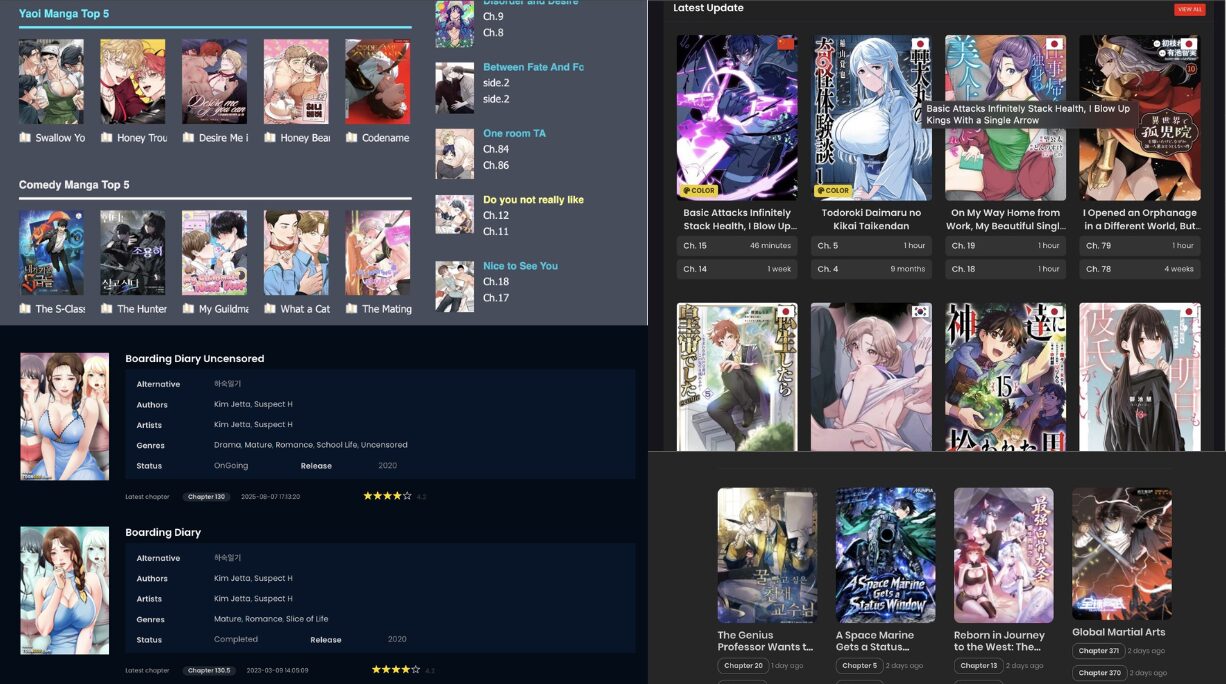
Popular manga resources
On these sites, you can see which storylines are currently “trending,” and sometimes even buy ad placements directly. And even if you don’t plan to drive traffic from here, these platforms are an invaluable source of insights for creating landing pages and creative assets. See what people are reading and adapt the story to your campaign.
As for geography, comics perform best in markets with a culture of storytelling and visual content. I recommend testing the following first:
- The U.S. – the largest audience + high purchasing power;
- the UK, Canada, Australia, and New Zealand—a stable English-speaking audience with good CPM performance;
- France – a special case: storytelling works well there, especially with adapted creatives and localization.
As always, it all depends on the type of traffic you’re working with, so Cpamatica managers are always ready to provide more detailed advice on which product to launch in which region to get the best results with your approach.
Tools for affiliates
Another advantage of this niche is that it’s easy to get started. At Cpamatica, you’ll find everything you need to get going: ready-made creatives, proven landing pages, and tools that can be adapted to your approach.
What we offer:
- ready-made creatives: images of real comic book characters that can be adapted to any angle;
- the ability to tailor the sales funnel for fantasy, romance, drama, or something even more daring;
- frequent content updates: new stories are released regularly, helping you keep your audience engaged;
- a wide variety of hooks: fantasy, intimacy, intrigue, action, and plot twists.
In other words, you don’t need to tailor your strategy to what already exists. Cpamatica provides a foundation for a quick start, and from there you can test your own approaches – we’ll help you adapt the creatives and funnels to suit them.
This niche doesn’t tie you to a single direction – on the contrary, here you can really test and scale according to your own strategy.
How the funnel is structured: hook, intrigue, subscription
In comics, the funnel is built right into the storyline. The main tool is the hook—a moment of suspense or unresolved tension that compels the user to keep going. A typical structure looks like this:
- Creative – an intriguing panel, action, or line of dialogue that sparks surprise or curiosity;
- Landing page – the first free episode starting from the point where the plot is already in motion;
- Engagement – 3 episodes available before the paywall;
- Paywall – to find out what happens next, you need to subscribe.
Let’s look at an example from a real ad.
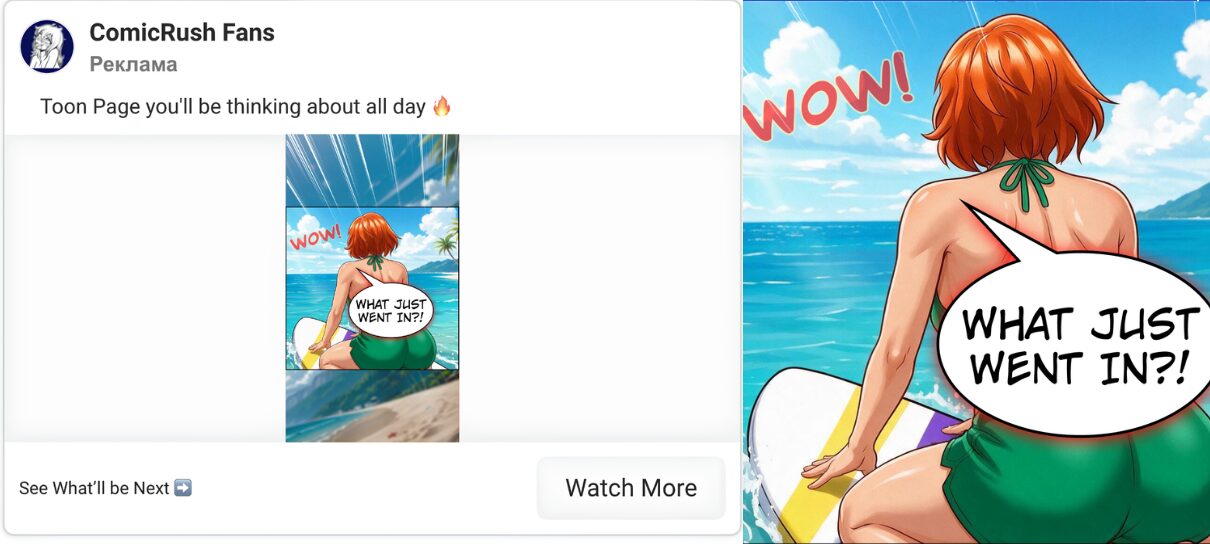
Ad creative: “Toon Page you’ll be thinking about all day!”
The creative features a shocked heroine; the frame is taken from the middle of the action. Call to action: “Read comic.” The ad leads directly to the first free episode, which serves as the landing page.
In this funnel, the user isn’t guided through pre-landing pages or separate pages—they’re immediately immersed in the story. This shortens the path and reduces traffic loss at every step.
What to use in the campaign:
- in creatives – scenes with unfinished action or drama;
- in the funnel – a minimal number of steps: teaser → story → subscription;
- in the content structure – several free episodes that lead to a strong hook.
The key here is not to “sell,” but to intrigue. And if the story is done right, it will drive the conversion.
ComicRush: What the conversion funnel looks like in the comic book niche
One example that effectively implements everything described above is ComicRush. It’s a platform – exclusively available on Cpamatica – featuring illustrated stories: suspense, visuals, romance, and subtle hooks. Its monetization model is based on subscriptions.
Here’s how the funnel works:
- The user sees a teaser for the story.
- They dive into the story and read a few free chapters.
- At a certain point, a paywall appears – to access the rest of the story, they need to subscribe.
The cheapest subscription costs $9.99 per week, but four plans are available: 1, 4, 12, and 24 weeks. Uncensored content (i.e., uncensored scenes) is only unlocked in plans of 12 weeks or longer – this gently encourages users to choose more expensive options.
Benefits for affiliates:
- the conversion point is predictable—it’s always the same moment;
- there are ready-made visuals and flexible storylines—no need to start from scratch;
- stories are constantly updated—there’s plenty to test and keep users engaged.
ComicRush is a content product with a clear engagement strategy. That’s exactly why it attracts partners’ attention.
Storytelling that sells
So, while everyone is flooding the dating space and fighting for every click in an overheated auction, comics remain off the radar for most. Cpamatica already has a ready-made database of offers for testing: ComicRush, Honeytoon, Peachytoon, Toonhub, plenty of creatives and landing pages, and regular content updates.
For affiliates, this is an opportunity to enter a vertical with less noise, familiar logic, and good potential. If you craft the story skillfully, the user will push themselves to make the payment on their own.
As an affiliate manager, I see that people are approaching this niche cautiously for now – and that’s precisely where its strength lies. There’s room here for testing, for creativity, and for launching campaigns that bypass well-worn approaches. This isn’t a hype wave that will rise and fall; it’s a format that’s sustained by genuine interest, not empty promises.
Want more practical experience? Join our Telegram blog by Cpamatica’s affiliate managers – there, we share real-world case studies, strategies, and insights on working with dating, comics, and other verticals.

- 9
- 0
- 0
- By rating
- In order